The node controller (also known as zone or area controller) acts as the critical middle‑layer communication hub inside a complete parking guidance system. Sitting between parking detectors and the central controller, it undertakes regional data collection, signal forwarding and local management tasks. Without node controllers, large‑size parking lots would face unstable long‑distance signal transmission and difficult system expansion. Sintronic node controllers have been widely deployed for overseas parking projects in Malaysia, Dubai and other regions.
Core Working Principle of Node Controller
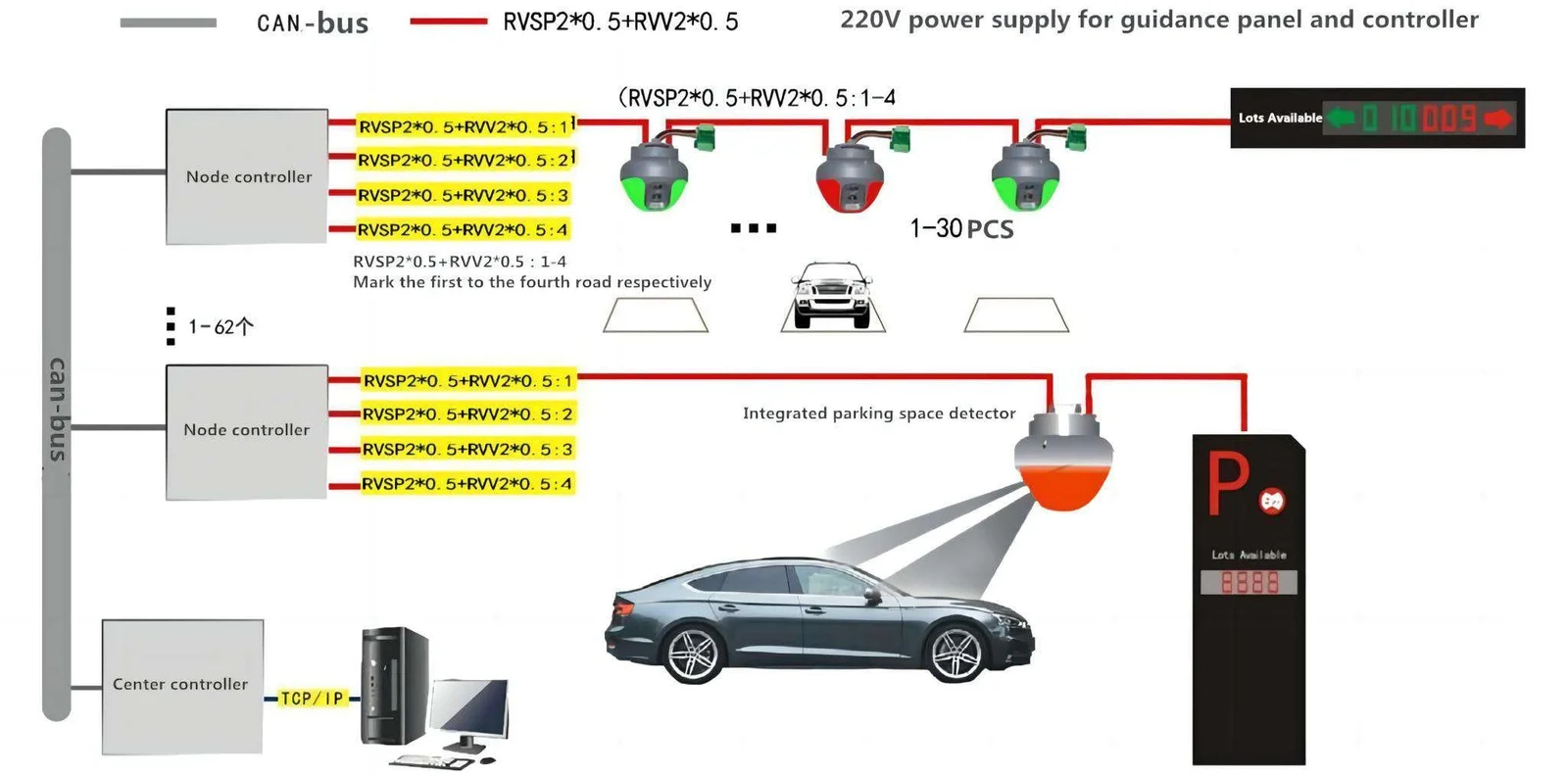
Sintronic parking guidance adopts mature three‑tier network architecture: Parking Detector → Node Controller → Central Controller. The node controller runs cyclic polling to collect status from every connected parking sensor. The full workflow is shown below:
1. Down‑link data collection from parking detectors
Via industrial RS485 bus, each node controller cyclically polls all connected parking detectors (split‑type or integrated detectors). It continuously gathers real‑time bay status: occupied, vacant or offline fault. One Sintronic node controller can manage a group of parking detectors within one zone or underground floor, solving signal attenuation problems over long wiring distances in large garages.
2. Local data pre‑processing & filtering
Raw sensor data will be filtered locally on the node controller. It removes noise interference caused by underground pipeline, dust or unstable power supply. It counts available parking spaces for its own zone and detects hardware failures of connected detectors. Even when communication with upper central controller is temporarily lost, the node controller can keep local guidance screens running for independent zone operation.
3. Upload aggregated data toward central controller
After local processing, condensed zone‑level parking data is transmitted upward to the central controller. Instead of sending massive raw data of every single sensor, it transfers compressed zone statistics to reduce total network load for the whole parking guidance system.
4. Execute downward command & drive local guidance devices
The node controller also receives commands delivered down from the central controller. It drives local aisle LED guidance signs, zone displays and bay indicator lights to update real‑time vacant‑space information for drivers. It reports device fault alarms for maintenance teams.
Key Differences Between Node Controller and Central Controller
Many integrators confuse node controller with central controller. Clear distinction helps system design:
Node Controller (Middle‑layer hub): Manages one zone / floor; collects data from local detectors; handles regional communication; supports partial offline zone operation.
Central Controller (System brain): The top master unit; receives data from multiple node controllers; runs full‑lot calculation; connects to management PC software for overall system monitoring.
Internal link tip: Link this paragraph to your article Working Principle of Central Controllers in Parking Guidance System.

 Indonesia
 Malaysia
 Saudi Arabia
 United States
 South Africa
 Germany
 Russia
 Italy
Italy Portugal
 Vietnam
 Zimbabwe
 South Korea
 Ruben| Project Manager | Sintronictech is Reliable supplier