Operation of Facial Recognition Unit in Modern Integrated Access‑Control Solution
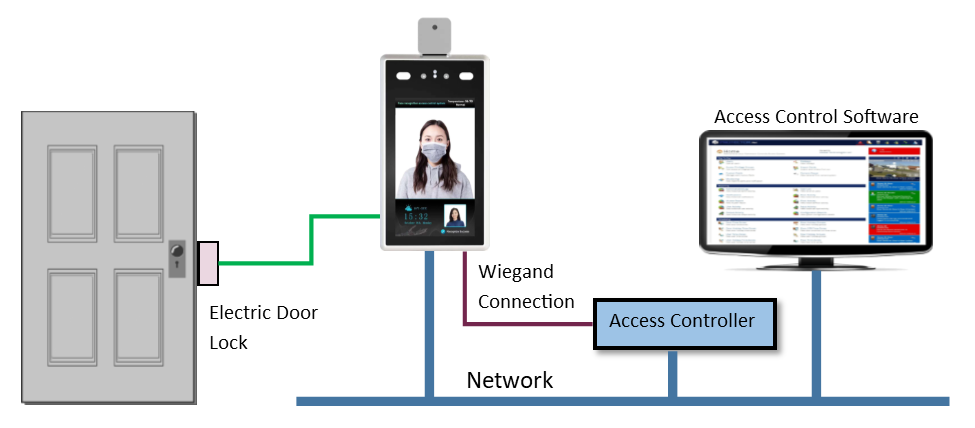
A facial recognition unit is a biometric front‑end verification terminal for modern access‑control systems. Equipped with dual‑lens RGB‑IR camera, deep‑learning AI algorithm and anti‑spoofing liveness‑detection module, it performs touch‑free identity verification and outputs standard Wiegand or RS485 authorization signals. It can connect to 32‑bit /64‑bit /128‑bit access controllers, elevator cabinet multi‑door controllers and full‑series pedestrian turnstile gates. Multiple credential modes are supported: facial scan, RFID card, QR‑code and PIN code.
Core Working Principle of Facial Recognition Unit
Sintronic facial recognition unit follows touch‑free biometric access workflow: User Enrolment → Face Detection & Liveness Check → Biometric Feature Extraction → Template Matching → Signal Output → Event Log Recording. Full‑cycle operation steps are described as follows.
1. Pre‑enrolment phase
System administrators complete user enrolment via ACS‑‑SW access‑control management software or local terminal operation. The unit captures facial biometric information and converts it into irreversible encrypted mathematical templates, instead of storing original face photographs. Encrypted templates are saved in local on‑board flash memory. The terminal supports offline verification without continuous PC‑server connection.
2. Face detection and anti‑spoofing liveness check
When a pedestrian approaches the unit, the dual‑lens RGB‑IR sensor automatically detects human‑face targets within valid recognition distance. The built‑in liveness‑detection algorithm distinguishes real human faces from fake spoofing sources such as printed photos, screen pictures or masks, to block fraudulent access attempts. If liveness verification fails, the process terminates immediately and access is rejected.
3. Biometric feature extraction
After passing liveness validation, the AI chip extracts unique facial landmark feature points (eye spacing, nose contour, jaw‑line geometry etc.) and converts live facial data into a real‑time biometric template.
4. Local template matching comparison
The newly‑generated live template is compared against pre‑stored encrypted user templates inside local memory. The algorithm calculates similarity score. When the score meets the pre‑configured security threshold, identity verification is judged as passed.
5. Authorization signal output to downstream hardware‑ Verification passed: The unit outputs Wiegand / RS485 valid‑access signal. The connected access controller, elevator controller or turnstile gate receives trigger signal and unlocks door / activates elevator floor permission / opens pedestrian barrier. LED and audio prompt indicate access granted.
‑ Verification failed: No trigger signal is sent; local prompt informs access denial.
6. Event log recording & optional network sync
Every verification activity including successful entry, failed attempts and spoof‑detection alarms is saved as encrypted event log in local storage. When TCP/IP network is available, logs synchronize to ACS‑SW management software for audit and attendance reporting. If network drops offline, logs are cached locally and auto‑sync once network connection restores.

 Indonesia
 Malaysia
 Saudi Arabia
 United States
 South Africa
 Germany
 Russia
 Italy
Italy Portugal
 Vietnam
 Zimbabwe
 South Korea
 Ruben| Project Manager | Sintronictech is good