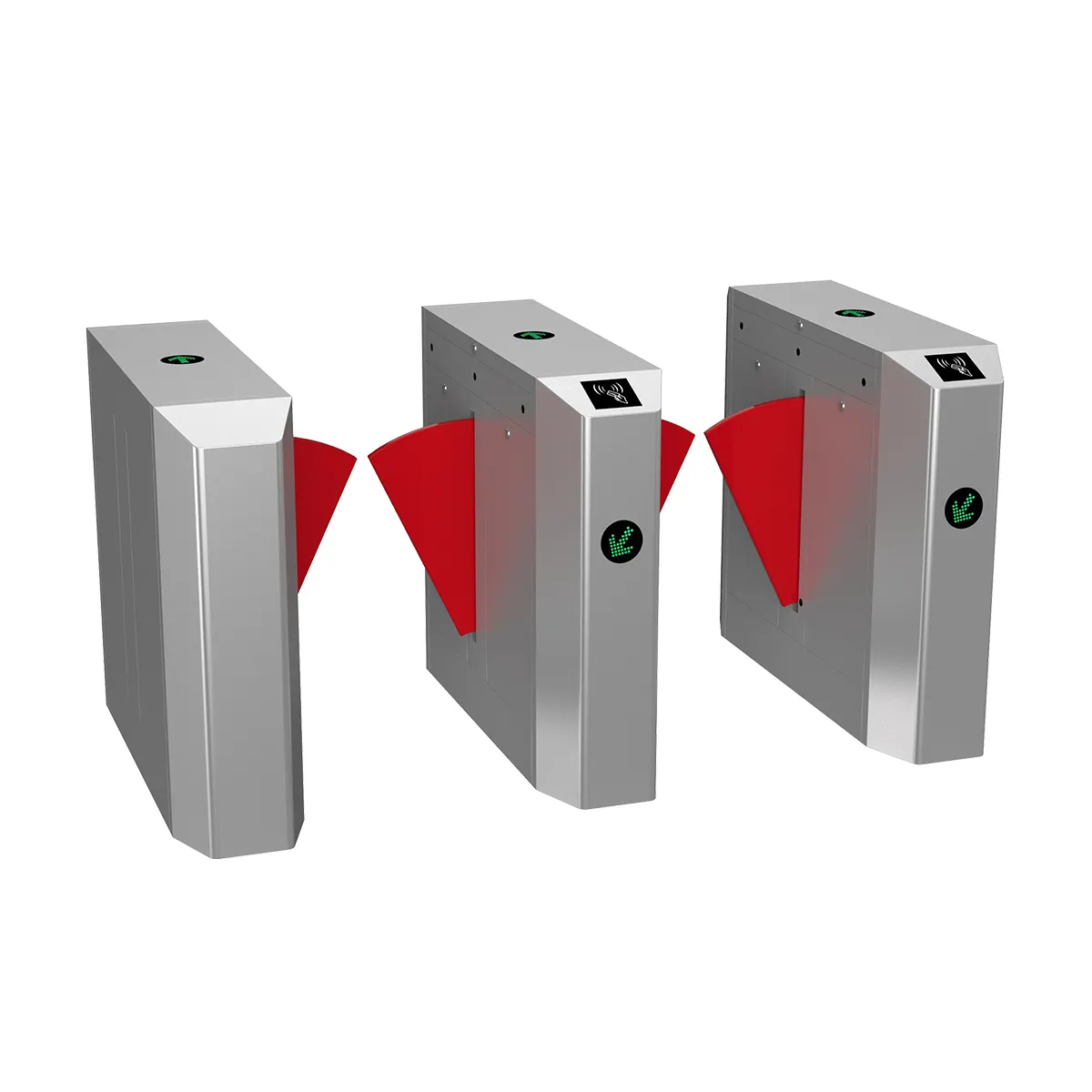
A wing turnstile, also widely known as flap barrier gate, is a modern high‑performance pedestrian barrier for complete turnstile gate system. Different from tripod turnstile which uses rotating three‑arm rods, it adopts retractable tempered‑glass or acrylic wing panels driven by brushless DC motors. Combined with multi‑pair infrared detection sensors, it achieves fast passage, anti‑tailgating and anti‑pinch protection. It supports multiple credential modes including RFID card, QR‑code, fingerprint and facial recognition. Sintronic wing turnstiles have been deployed for overseas access‑control projects including Kuwait and Saudi Arabia pedestrian‑gate reference projects.
Core Working Principle of Wing Turnstile
Sintronic wing turnstile follows modern access‑control workflow: Credential Validation → Signal Input → Wing Retraction → Infrared Passage Monitoring → Wing Auto‑Reset & Lock. Full‑cycle operation steps are described as follows.
1. Standby locked status
Under normal standby condition, wing panels extend outwards to form solid physical barrier. Multi‑channel infrared sensors keep scanning the whole passage lane. LED indicator shows red light and waits for valid authorization signal.
2. Credential verification & signal input
Pedestrians present valid credentials: RFID IC card, QR‑code, fingerprint or facial recognition. After identity validation passes, the external reader sends Wiegand or dry‑contact signal to wing turnstile main‑control board.
3. Motor‑driven wing retraction for passage opening
Upon receiving valid pass signal, brushless DC motor drives wing panels retract horizontally into both‑side cabinet within short opening time. LED status changes to green, allowing pedestrian to enter the lane.
4. Infrared real‑time passage monitoring
During pedestrian passing, dense infrared sensor array continuously tracks pedestrian moving position, direction and number of people entering the lane.
Anti‑tailgating: System triggers audio‑visual alarm if second person tries to sneak through under single authorization.
Anti‑pinch safety: If obstruction is detected while wings are closing, motor immediately stops and reverses movement to avoid hurting pedestrians.
5. Automatic wing extension & return to locked standby
After the pedestrian fully clears all infrared beams, the control board triggers the motor to push wing panels back to extended locked position. LED turns back to red and the turnstile returns to standby status for next user.
6. Emergency power‑off safety function
When main power supply fails, built‑in fail‑safe mechanism activates. Both‑side wing panels fully retract into cabinet, completely clearing passage for emergency evacuation, complying with public‑building fire‑safety requirements.

 Indonesia
 Malaysia
 Saudi Arabia
 United States
 South Africa
 Germany
 Russia
 Italy
Italy Portugal
 Vietnam
 Zimbabwe
 South Korea
 Ruben| Project Manager | Sintronictech is good