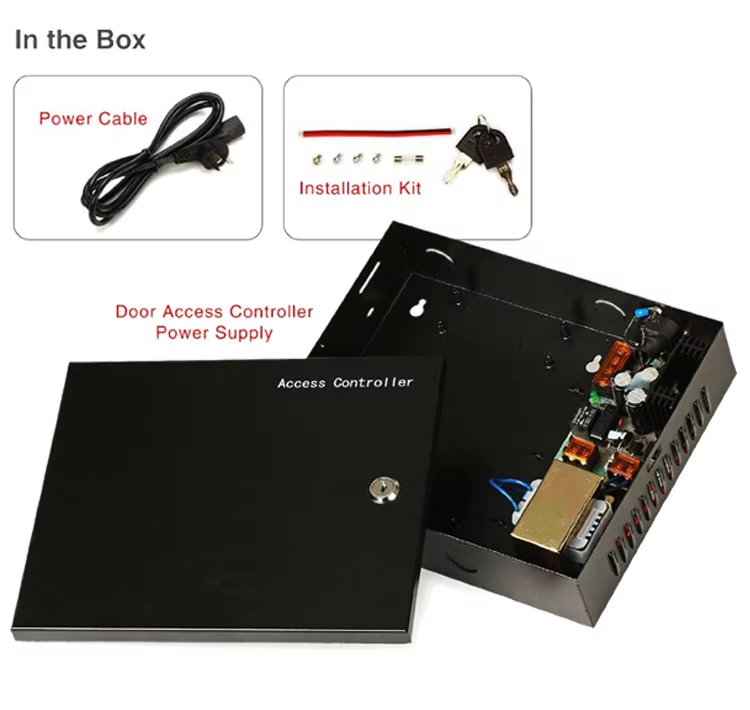
A power box (access‑control power supply box) is the critical power‑conversion and power‑distribution backbone hardware for complete access‑control systems. It converts alternating‑current mains AC input into stable regulated DC 12V / 24V output to feed access controllers, credential readers, electric door locks and pedestrian turnstile gates. Equipped with sealed lead‑acid battery UPS backup interface, it enables seamless automatic switch‑over during mains power failure. Built‑in overload, short‑circuit and surge‑protection circuits prevent hardware damage. Sintronic power boxes have been deployed for overseas access‑control projects including Nigeria and Saudi Arabia multi‑floor commercial‑building reference projects.
Core Working Principle of Power Box in Access Control System
Sintronic power box follows regulated power‑supply workflow: AC‑DC Conversion → Regulated DC Power Distribution → Battery Float‑Charging → Auto UPS Switch‑Over on Power‑Failure → Protection Trigger on Fault Conditions. Full‑cycle operation steps are described as follows.
1. Normal mains‑power operating status
When building AC mains power is available:
‑ Power‑conversion module converts AC input into stable DC12V or DC24V regulated output.
‑ Power is distributed to downstream hardware: access controllers, fingerprint / RFID / facial‑recognition readers, electromagnetic locks, dropbolt locks or pedestrian turnstile gate units.
‑ Meanwhile, built‑in charging circuit performs safe float‑charging for connected SLA backup battery, keeping battery fully charged without over‑charging risk. Mains‑power‑OK LED indicator lights up.
2. Mains‑power failure / blackout mode (UPS backup activation)
Once AC mains power is lost (power outage, circuit fault):
‑ Power box triggers zero‑delay automatic UPS switch‑over. The connected backup battery takes over power supply instantly for the whole access‑control system without power interruption.
‑ Access controllers, readers, door locks and turnstile gates keep functioning normally: credential verification, unlock trigger, event‑log recording all remain operational.
‑ When mains AC power is restored, power box automatically switches back to mains‑power mode and resumes battery float‑charging.
Important safety note: For fail‑safe electromagnetic mag‑locks, doors will release upon power loss. UPS backup mainly keeps controllers and readers alive for identity‑verification and log recording. For fail‑secure dropbolt locks, UPS power maintains locked state during blackout for security requirements.
3. Output power distribution for downstream hardware
Multiple protected DC output terminals deliver power to each access‑control component independently.
‑ For access‑controller units: Stable low‑ripple DC supply for main‑board computation, flash‑memory storage and communication ports.
‑ For credential readers (RFID, fingerprint, face, keypad, QR‑bar‑code): Steady power for sensor, biometric chip and indicator lights.
‑ For electric locks: Sufficient current for electromagnetic‑lock magnetic‑holding or dropbolt‑lock solenoid actuation.
‑ For pedestrian turnstile gates: Continuous power for main‑control board, motor‑drive unit and infrared‑sensor arrays.
4. Overload & short‑circuit fault‑protection mechanism
If downstream wiring short‑circuit or hardware overload occurs on any output channel:
‑ PTC self‑recovering protection circuit cuts off power on the faulty channel automatically. Other output channels remain functional to avoid total‑system shutdown.
‑ Fault‑status LED provides visual warning. After eliminating wiring or hardware fault, the channel auto‑resumes power output without manual fuse replacement.
5. Low‑battery protection
When backup‑battery voltage drops below pre‑defined threshold under UPS working mode, power box activates low‑battery protection to prevent deep‑discharge damage which shortens battery service life. System will gradually shut down non‑critical loads to preserve power for core security hardware.

 Indonesia
 Malaysia
 Saudi Arabia
 United States
 South Africa
 Germany
 Russia
 Italy
Italy Portugal
 Vietnam
 Zimbabwe
 South Korea
 Ruben| Project Manager | Sintronictech is good